

TL;DR
We are entering an era of heterogeneous compute, where general-purpose AI accelerators are replaced with systems of specialized hardware.
A more heterogeneous compute stack creates opportunities for middle powers that lag the US and China on advanced AI capabilities.
But middle powers will not benefit by default. The shift to a more heterogenous stack is a test case for sovereign AI industrial strategy.

Cerebras WSE-3. Source.
Introduction
‘Remember, Nvidia is an accelerated computing company, not a GPU company’.
AlexNet is often credited with kickstarting the current wave of AI progress. Built by Alex Krizhevsky, Ilya Sutskever and Geoffrey Hinton, AlexNet won the 2012 ImageNet challenge, demonstrating that neural networks trained on large datasets with Nvidia GPUs could outperform other approaches. This insight still underpins AI progress today.
What happened after AlexNet is less well known. When Alex Krizhevsky joined Google in 2013, he was shocked to discover that the search giant was still using CPUs for AI workloads. CPUs are optimized for sequential processing, performing a few complex tasks, one after another. GPUs, by contrast, are optimized for parallel processing, performing many simple calculations simultaneously. This makes them ideal for training AI systems.
So Krizhevsky went to a local electronics shop and loaned some GPUs. He plugged them into a closet down the hall from his desk and kept building. It took about a year for Google to catch up. In 2014, the company made the decision to buy 40,000 Nvidia GPUs for $130m.
Since then, GPUs have become the currency of AI progress. Google now owns an estimated 1.3m Nvidia GPUs, plus a further 3.8m GPU equivalents (TPUs, H100e). Microsoft owns 3.2m. Thousands have been sold to global governments under the banner of ‘sovereign AI’.
Corporate success and national ambition are now measured in compute, and compute often means GPUs. This demand has driven Nvidia’s valuation to over $5tn, from around $10bn when the Google order arrived in 2014.
So it was notable when Nvidia told developers in March to look beyond GPUs. At GTC 2026, CEO Jensen Huang argued that GPUs are not enough. Or more specifically, ‘optimizing the entire pipeline for only one regime forces a compromise’.
This post explains why GPUs are no longer enough, and explores the geopolitics of a more heterogeneous compute stack. What happens to the balance of power when general-purpose accelerators are replaced with systems of specialized hardware?
Heterogeneity Today
Let’s start with some background. AI systems are developed (training) and then used in deployment (inference). But training and inference are composed of several distinct workloads, each with different compute, memory bandwidth and memory capacity demands.
Inference can be divided into prefill and decode. Prefill processes the input, while decode generates the output. Prefill is compute intensive but parallelizable: many input tokens can be processed in tandem. Decode is memory intensive and sequential: token #2 can only be generated after token #1, and generating each token means loading the model weights and a key-value (KV) cache storing representations of past tokens.
The demands of prefill and decode are therefore different. When computing power (measured in FLOPs) advances faster than memory bandwidth (measured in TB/s), inference becomes increasingly bottlenecked by decode, the more memory intensive stage. This is the ‘memory wall’ some have warned about.
Yet prefill and decode are only half the story. Both can be divided again into feed-forward network (FFN) and attention operations. FFN operations transform each token independently, multiplying it against the model weights to apply knowledge learned during training. Attention operations mix information across tokens, letting each one draw on the context around it, using representations stored in the KV cache.
Prefill FFN is compute intensive: many input tokens can be multiplied against the model weights in parallel. Prefill attention is similarly compute intensive, but is also memory capacity bound: the KV cache must be held somewhere, and can run to hundreds of GB for long context inputs.
Decode FFN flips to being bandwidth intensive: the full weights must be loaded to multiply against each output token. Decode attention is similarly bandwidth intensive, but is also memory capacity bound: the KV cache must be loaded at every step, and grows with each output token.
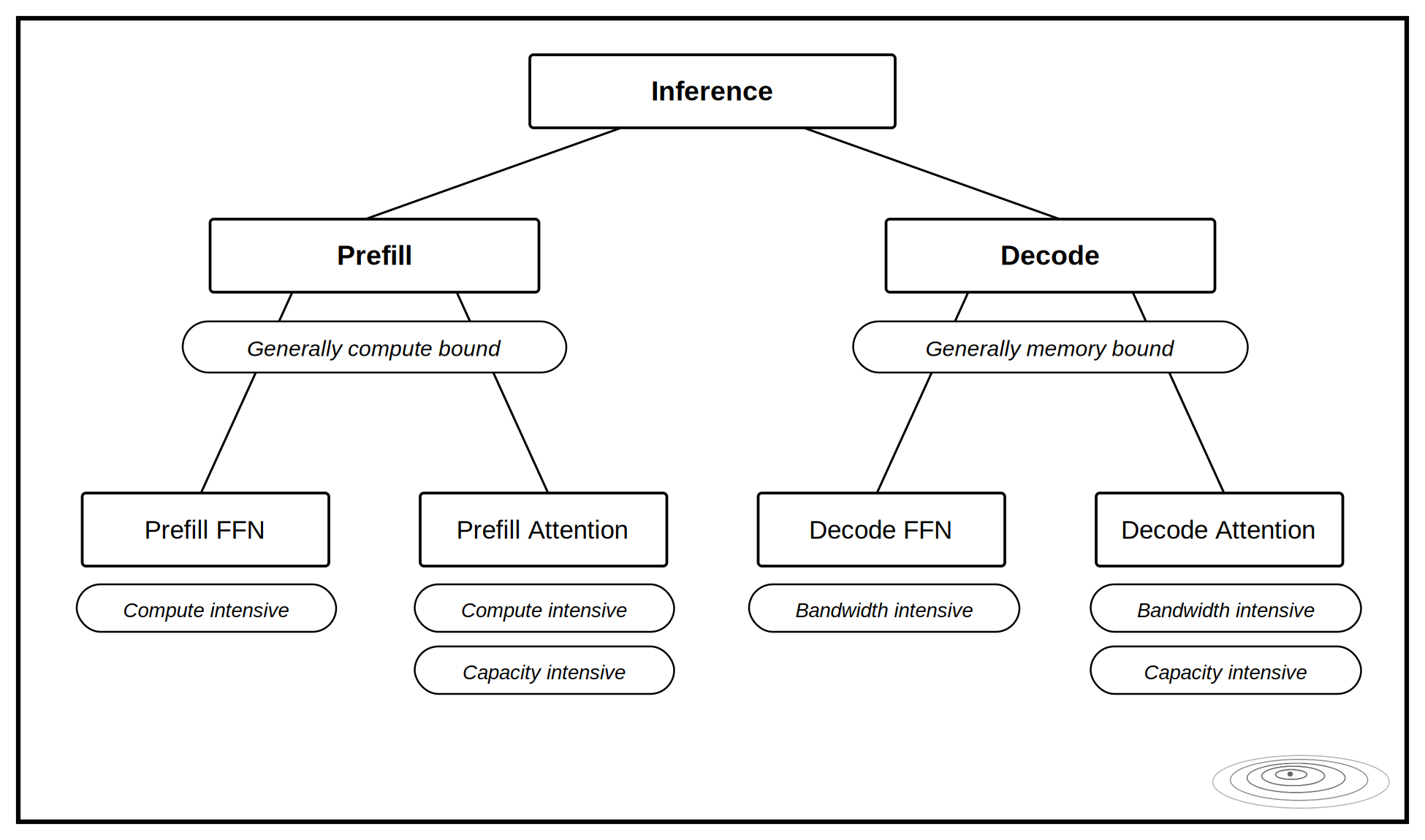
Simplified breakdown of inference into prefill, decode, FFN and attention operations. In practice, specific compute and memory demands are a product of architecture, attention mechanism, batching, context length, etc.
This distinction between prefill, decode, FFN and attention operations explains Nvidia’s argument. GPUs boast massive computing power and memory capacity. But specialized hardware still beats them on memory bandwidth.
Nvidia has therefore spent $20bn acquiring Groq. Groq’s Language Processing Unit (LPU) uses massive on-chip SRAM to improve bandwidth: the Groq 3 LPU boasts bandwidth of 150 TB/s, compared to 22 TB/s for Nvidia’s Rubin GPU.
Nvidia is ‘unifying’ these chips in a single system. The GPU will handle prefill, which is generally compute intensive, as well as decode attention, which is more memory capacity bound. The LPU will meanwhile handle decode FFN, which is more memory bandwidth bound.
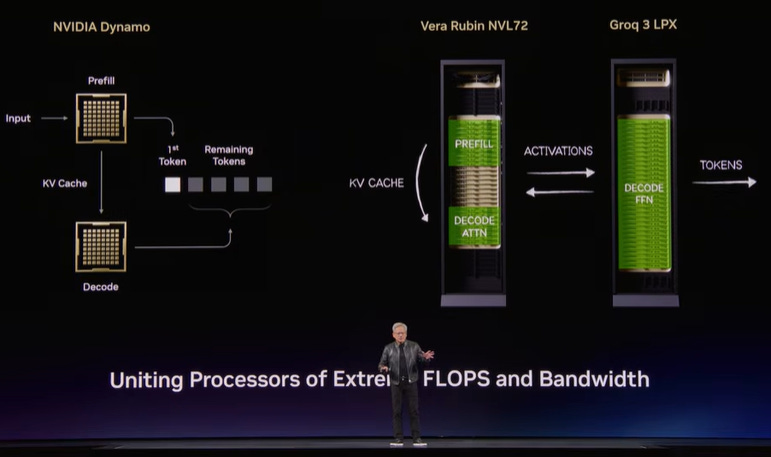
Attention-FFN disaggregation at GTC 2026. See right side. Source.
This is a form of disaggregated inference, specifically attention-FFN disaggregation (AFD). AFD promises to extend the throughput-latency Pareto frontier, where throughput is measured in tokens-per-second per megawatt and latency is measured in tokens-per-second per user. By extending the Pareto frontier, entirely new AI applications become possible.
(It is an interesting side note that some of the first papers on AFD came from Chinese companies ByteDance and StepFun.)
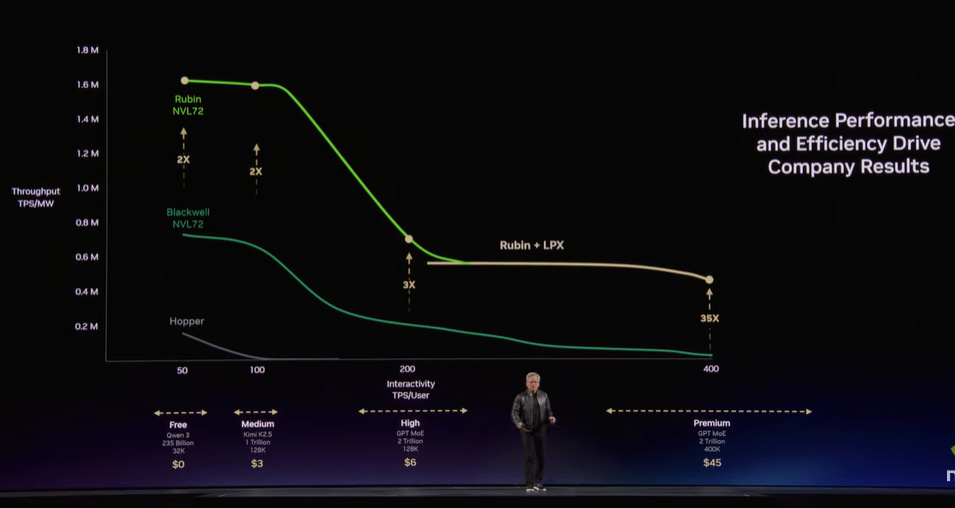
Rubin GPU plus Groq 3 LPU extends the Pareto Frontier. See yellow line. Source.
GTC 2026 was not Nvidia’s first foray into disaggregated inference. In 2025, the company announced the Rubin CPX, a chip specialized for prefill. Yet it marked a moment, the world’s leading chip designer using its annual conference to argue that specialized chips beat GPUs.
It was also surrounded by a flurry of similar announcements. Amazon and Cerebras announced disaggregated inference on AWS, with Trainium for prefill and Cerebras’ WSE (another SRAM chip) for decode. Intel and SambaNova announced a new system with GPUs for prefill and SambaNova’s RDUs for decode. China’s Moonshot proposed ‘prefill-as-a-service’: prefill and decode split between different hardware in different datacenters.
Taken together, these announcements seem to signal the start of a more modular computing ecosystem. An age of heterogeneous compute, where general-purpose accelerators are replaced by systems of specialized hardware.
Heterogeneity Tomorrow
There are many reasons to believe that this trend toward heterogeneous compute will continue. Disaggregated inference is only one approach to extend the throughput-latency Pareto frontier. There is also a broader move toward hardware-software co-design.
Nvidia won the ‘hardware lottery’ with the GPU. A chip originally designed for gaming evolved into a general-purpose accelerator. But such flexibility comes with costs: chips intentionally designed for specific AI systems now promise to improve efficiency.
Chips can be co-designed at different levels of abstraction. Taalas is pursuing perhaps the most extreme co-design, producing chips specialized to run specific AI systems, such as Llama 3.1 8B. Etched is a level up, producing chips for transformer models. MatX is meanwhile betting on the mathematical primitives that compose transformers, optimizing for a wider range of architectures, such as large sparse LLMs.
Co-design is not entirely new. Google considered building custom chips for AI systems back in 2006; the TPU first entered production in 2016. Google describes the latest generation of TPUs as the culmination of a decade ‘co-designing silicon with hardware, networking and software, including model architecture’.
But such co-design is increasingly the norm. Hence OpenAI has a partnership with Broadcom to ‘embed what we’ve learned from creating frontier models and products directly into the hardware’. And Anthropic is reportedly considering a custom chip.
Co-design should further increase chip diversity. If disaggregated inference produces chips specialized for stages in the inference process, co-design produces chips optimized for specific AI systems. But what does this more modular stack mean for geopolitics?
Implications for Geopolitics
In their 2000 classic, Design Rules, Carliss Baldwin and Kim Clark explore the impact of IBM’s first modular computer. The System/360 was a family of mainframe computers introduced in 1964, with around 25 independent hardware modules.
Baldwin and Clark identify two main impacts. The first was ‘multiplication of options’. New companies entered the market to provide ‘plug compatible’ components for the System/360. By 1996, 90% of the firms and 70% of the market value of all ‘computer’ companies was in sectors that did not exist when the System/360 was released.
The second impact was ‘decentralization of options’. Rather than simply accepting an integrated system, users could now configure modules to meet their needs. Decisions over how the system should be designed shifted from ‘the center to the periphery’. This allowed the system to evolve rapidly, far faster than traditional product cycles.
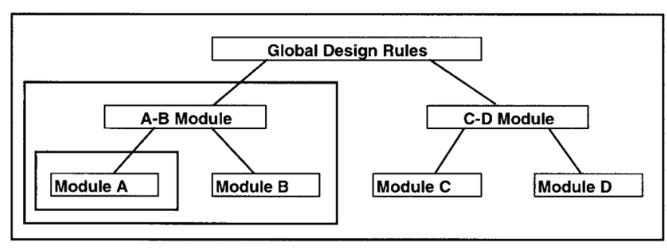
An illustration of modular architecture from Baldwin and Clark. Should look familiar! Source.
We can apply the same framework to heterogeneous compute. A more modular stack creates opportunities for specialization (multiplication of options) and substitution (decentralizing control). These effects could benefit middle powers that lag the US and China on advanced AI capabilities.
Opportunities for Specialization
The US and China control 90% of global compute and employ 70% of the world’s top AI researchers. This makes it difficult for middle powers to compete.
But middle powers can produce hardware that contributes to the overall efficiency of AI training and inference. If the trend toward heterogeneous compute continues, chip startups could become geopolitical assets that increase the leverage of middle powers.
But this assumes that specialized chip startups can compete. The Nvidia R&D department has over 31,000 employees, and spent $18bn in FY 2026. The Rubin CPX and Groq acquisition show willingness to invest in specialized hardware. So what stops Nvidia building a heterogeneous stack in house?
There are a few reasons to be bullish:
Technical and market risk: AI research runs in roughly 6-9 month cycles. New chips can take three years to reach the market. Hardware startups must therefore predict the direction of AI progress. It is not guaranteed that they will predict correctly: this is particularly acute for startups pursuing co-design at lower levels of abstraction. Nvidia might let startups take the risk of bringing specialized chips to market.
Testing and verification costs: Increasing automation in chip design promises to lower testing and verification costs for startups, while also reducing time to first production (tape-out). At the most extreme end of this trend, companies like Ricursive Intelligence are trying to automate the entire design process, enabling a class of ‘designless’ companies the same way that TSMC allowed Nvidia to emerge as a ‘fabless’ company.
Secular demand: The inference market is massive and growing. Increasing AI adoption and the proliferation of agents will further increase demand. In this context, Nvidia could lose market share and still increase revenues. Nvidia’s market share would likely have already fallen with a more aggressive strategy from Google, which has been slow to commercialise TPUs since first making them available to cloud customers in 2018.
But competing will not be easy:
Supplier relationships: The semiconductor supply chain is tightly networked, with relationships that have persisted through decades of boom and bust. Nvidia’s strategic partnership with TSMC dates to a personal letter from Jensen Huang to TSMC CEO Morris Chang in 1997. Replicating the broad and deep relationships required to bring a new chip to market represents a challenge for any hardware startup.
Production volumes: Even with significant investment from TSMC, demand from chip designers is outpacing fabrication capacity. This leaves TSMC in the role of kingmaker, allocating capacity to competing customers. While the company has historically been keen to sustain a ‘customer base that is broad and diverse’, reliability also matters. And as Jensen Huang argued recently, ‘every single year, you can count on us’.
So seizing the specialization opportunity will not be simple. Middle powers need to support startups to demonstrate viability at low volumes, through initiatives like the UK’s Scaling Inference Lab. Middle powers will also need strong anti-appropriation regimes, to stop startups that take the risk of bringing new chips to market being acquired before scale. It may not be long before the next ‘Google buys DeepMind’ moment.
Opportunities for Substitution
A more heterogeneous stack also creates opportunities for substitution. Specialized chip startups should reduce dependence on Nvidia, allowing middle powers to diversify and bargain for better terms with a company that posted net profit margins of 55.6% last fiscal year. This has direct benefits for countries making deals for ‘sovereign AI’ and downstream economic benefits for domestic companies.
But this assumes switching costs are low. Greater chip diversity is irrelevant if moving between suppliers is impossible, and vertical integration outperforms more diverse setups. So can modular approaches compete with Nvidia’s integrated ecosystem?
Again, there are a few reasons to be bullish:
Existing precedent: AI companies have already swapped dependence on Nvidia for more diverse setups. Anthropic is the leading example: the company has agreements with Nvidia, AWS and Google. This seems to suggest that modular approaches can compete. As CEO Dario Amodei has said, ‘you actually gain benefits from heterogeneity’.
Comparative advantage: The fundamental principle of comparative advantage implies that combining chips specialized for different workloads and systems should push out the Pareto frontier. Performance benefits are akin to the gains from trade. There is some early evidence supporting this theory, beyond the vague claims made by AI company leaders.
But substitution will not be easy:
Full-stack co-design: We have discussed co-design at the chip level. But Nvidia can co-design across the full stack: from software, to interconnect, to GPU-GPU communication, to CPU-GPU communication. This unlocks outperformance that makes it hard for any modular approach to compete. Nvidia has been here before: despite releasing individually competitive chips, AMD has been unable to seize significant market share from Nvidia’s integrated ecosystem.
Falling portability: Even if switching costs are low today, they could increase in future. The dark side of co-design is lock-in: as hardware and software become more tightly coupled, it gets harder to move between suppliers. One explanation for Anthropic signing an early deal with AWS was the opportunity to co-design Trainium; Anthropic reportedly now has a team of Google engineers to optimize TPUs for Claude.
So substitution is far from given. To realize the substitution opportunity, middle powers will need to invest in interfaces that lower switching costs and enable modular approaches to compete with Nvidia’s integrated ecosystem. This explains why the first equity investment by the UK’s Sovereign AI Fund was into Callosum, a startup that is building the orchestration layer for a more heterogeneous stack.
Outlook
Middle powers are in a tough spot. If they cannot compete with the US and China on advanced AI capabilities, they need to meet two broad objectives:
Positive leverage: Networked dependencies that increase the likelihood of access to advanced AI developed overseas.
Negative resilience: The ability to sustain critical functions if dependencies such as access to advanced AI are weaponized by the US and China.
These objectives are naturally in tension. But the shift to a more heterogenous stack creates rare opportunities across both leverage and resilience.
Heterogeneity creates opportunities to specialize, allowing middle powers to capture some of the economic benefits of AI progress, and become key to the efficiency of AI training and inference overall. Specialized chip startups could join the menu of assets that contribute to meeting the positive leverage objective.
Heterogeneity also creates opportunities to substitute, allowing middle powers to both diversify and bargain with compute providers. Diversification is the archetypal resilience strategy, and bargaining will only become more important as global demand for compute intensifies, driven by adoption and agents.
Still, middle powers will not benefit from a more heterogeneous stack by default. Instead, the contours of an industrial strategy for sovereign AI can be seen in the actions middle powers will need to take. Horizon scanning for promising startups, plus direct support to demonstrate viability before scale, and compensate for a strong anti-appropriation regime, even with regard to allies. Strategic investment to open the interface, so specialized hardware companies can compete.
Nvidia is a product of the last time vertical integration was challenged in the chip business. The choices middle powers make now will determine where the next category-defining companies are built.
‘You’re not talking to somebody who woke up a loser.’
Many thanks to Kally Aleksiev, Jacob Feldgoise, Lennart Heim, Jack Wadham and Tom Westgarth for feedback and conversations that informed this post. All errors are my own.